
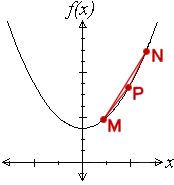
 The gradient at the point P can be approximated by using points that are near to P (such as M and N) and finding the gradient of the straight line between these points. The closer these points are to P the better the approximation will be.
We can find the gradient of PM and of PN. The gradient at P should lie between these two values. We can also find the gradient of MN which may give an even more accurate estimate.
This approach is called "differentiation from first principles"
This method may not be be part of your examination, but is here to give you a chance to see what lies behind the methods you use.
Summary/Background
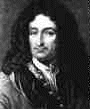 Leibniz (1646-1716) and Newton (1642-1727) independently discovered calculus. Their key idea was that differentiation and integration undo each other. Using this symbolic connection, they were able to solve an enormous number of important problems in mathematics, physics, and astronomy.
While in Paris Leibniz developed the basic features of his version of the calculus. In 1673 he was still struggling to develop a good notation for his calculus and his first calculations were clumsy. On 21 November 1675 he wrote a manuscript using the \int f(x) dx notation for the first time. In the same manuscript the product rule for differentiation is given. By autumn 1676 Leibniz discovered the familiar d(x^n) = nx^{n-1} dx for both integral and fractional n.
Leibniz (1646-1716) and Newton (1642-1727) independently discovered calculus. Their key idea was that differentiation and integration undo each other. Using this symbolic connection, they were able to solve an enormous number of important problems in mathematics, physics, and astronomy.
While in Paris Leibniz developed the basic features of his version of the calculus. In 1673 he was still struggling to develop a good notation for his calculus and his first calculations were clumsy. On 21 November 1675 he wrote a manuscript using the \int f(x) dx notation for the first time. In the same manuscript the product rule for differentiation is given. By autumn 1676 Leibniz discovered the familiar d(x^n) = nx^{n-1} dx for both integral and fractional n.
 Newton made contributions to all branches of mathematics, but is especially famous for his solutions to the contemporary problems in analytical geometry of drawing tangents to curves (differentiation) and defining areas bounded by curves (integration). Not only did Newton discover that these problems were inverse to each other, but he discovered general methods of resolving problems of curvature, embraced in his "method of fluxions" and "inverse method of fluxions", respectively equivalent to Leibniz's later differential and integral calculus. Newton used the term "fluxion" (from Latin meaning "flow") because he imagined a quantity "flowing" from one magnitude to another.
Software/Applets used on this page

This question appears in the following syllabi:
| Syllabus | Module | Section | Topic | Exam Year |
|---|---|---|---|---|
| AP Calculus AB (USA) | 3 | Differentiation | First principles | - |
| AP Calculus BC (USA) | 3 | Differentiation | First principles | - |
| AQA A-Level (UK - Pre-2017) | C1 | Differentiation | First principles | - |
| AQA AS Maths 2017 | Pure Maths | Differentiation | From First Principles | - |
| AQA AS/A2 Maths 2017 | Pure Maths | Differentiation | From First Principles | - |
| CBSE XI (India) | Calculus | Limits and Derivatives | Definition of a derivative | - |
| CCEA A-Level (NI) | C1 | Differentiation | First principles | - |
| CIE A-Level (UK) | P1 | Differentiation | First principles | - |
| Edexcel A-Level (UK - Pre-2017) | C1 | Differentiation | First principles | - |
| Edexcel AS Maths 2017 | Pure Maths | Differentiation | From First Principles | - |
| Edexcel AS/A2 Maths 2017 | Pure Maths | Differentiation | From First Principles | - |
| I.B. Higher Level | 6 | Differentiation | First principles | - |
| I.B. Standard Level | 6 | Differentiation | First principles | - |
| Methods (UK) | M8 | Differentiation | First principles | - |
| I.B. (MSSL) | 7 | Differentiation | First principles | - |
| OCR A-Level (UK - Pre-2017) | C1 | Differentiation | First principles | - |
| OCR AS Maths 2017 | Pure Maths | Differentiation Basics | From First Principles | - |
| OCR MEI AS Maths 2017 | Pure Maths | Differentiation Basics | From First Principles | - |
| OCR-MEI A-Level (UK - Pre-2017) | C2 | Differentiation | First principles | - |
| Pre-U A-Level (UK) | 4 | Differentiation | First principles | - |
| Scottish Advanced Highers | M1 | Differentiation | First principles | - |
| Scottish (Highers + Advanced) | HM1 | Differentiation | First principles | - |
| Scottish Highers | M1 | Differentiation | First principles | - |
| Universal (all site questions) | D | Differentiation | First principles | - |
| WJEC A-Level (Wales) | C1 | Differentiation | First principles | - |